California’s “Phone Free School Act” in Action at Culver High
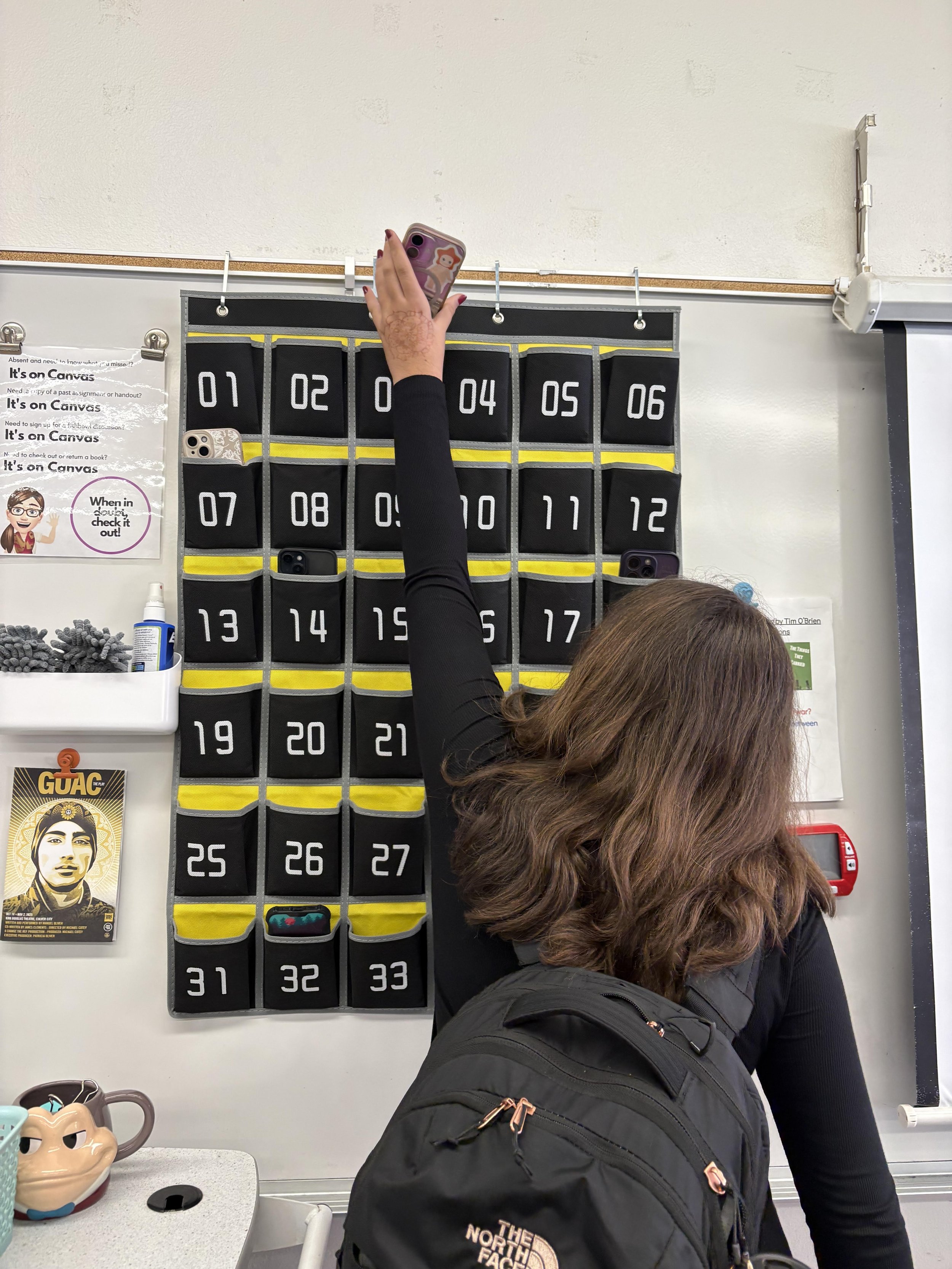
Leila Behforouz ('27) puts her phone in Ms. Barten's fabric phone holder at the start of class.
Whether it's a fabric calculator holder, a plastic bin, or a wooden phone caddy at the front of the classroom, Culver High’s approach to student phone use has changed completely in the past two years. With Governor Gavin Newsom’s signing of Assembly Bill 3216, the Phone-Free School Act, California became one of many states that have limited, or completely banned, cell phone usage in classrooms. The bill required every school district, charter school and county office of education to develop a policy limiting smartphone use by July 1st, 2026, with CCUSD being one of 977 districts adopting the change. As of November 23, 2025, 37 states in the US have established laws or policies surrounding student phone use in public school classrooms.
Concerns over phone use in Culver City schools did not begin this summer with the signing of the bill; talk of removing phones from classrooms has been circulating among teachers for years. Educators express concern over distraction in class, decreased social interaction and increased aggression, citing phone use as a root cause. However, some students and parents bring up safety risks with limited access to cell phones during school hours. Other opponents of policies restricting phone use point to concerns over equity and lack of education surrounding tech as potential drawbacks to the new restrictions.
The Evolution of CCHS’s Phone Policy
In an interview with Ms. Grasso—AP Environmental Science, Anatomy and Physiology and Health teacher— I got a chance to discuss some of these issues with one of the leading advocates for the new phone policy at CCHS.
Ms. Grasso has been an educator for over 20 years, spending the last 10 at Culver High and specializing in sciences. She also serves as one of our schools union representatives, where she advocates for the rights and wages of other teachers. She serves as the point person for teacher issues with school rules or policies. Nine years ago, when she started at Culver High, phone use was completely prohibited from school grounds, with teachers being instructed to collect any that they saw being used. She said that even though the policy was very restrictive, it was not effective at fighting the issue of phone use in class. Mandating that teachers be in charge of regulating cell phone use placed an added responsibility on teachers to be “phone police” on top of the normal demands of managing classroom behavior and instruction. Grasso said that in the 2015-2016 school year, she collected as many as 45 phones from students, a figure that highlights the drawbacks of this system for teachers. Over the years, the policy became more lax as phone use became more common, especially in the years following the COVID-19 pandemic.
A study on the technology use of teenagers in relation to the 2020 lockdowns says “As adolescents adjusted to a new normal, technology played a consistent role in facilitating relationships and community.” After 2 years of being trapped inside with only technology for company, it was especially difficult for students to monitor and regulate their own cell phone use in class.
“They were constantly looking at their phones, engagement was lower, they weren’t talking to each other, and if there was any free time at all they were always on their phones,” Ms. Grasso said about the conditions before this year's policy change.
Evidence in favor of a policy change was not purely anecdotal either. Recent studies have found a correlation between cellphone use in schools and lowered rates of academic achievement and higher rates of depression, anxiety and other mental health challenges.
The Current Solution
Ms. Grasso was far from the only teacher who noticed alarming changes in student behavior around technology. A plethora of teachers from all different grades and subjects came to her as their union representative, complaining that student phone use in class was “out of control”.
Distraction was not the only issue that plagued teachers. They were also facing conflicts with and aggression from students when trying to monitor phone use. When student-teacher conflicts over phones, and complaints from teachers finally reached a tipping point, the union representatives met with the administration to discuss potential solutions. An agreement ultimately came when teachers agreed to designate a phone storage container for class time, where phones would be left until the end of the period and returned for time outside of class.
The Other Side of the Debate
While most teachers view the solution as a win, many students and some parents have expressed dissatisfaction with the new policy. One point that opponents of this regulation bring up frequently in support of their arguments is a concern over student safety. Violent incidents and school shootings have tripled since 2013, and threats to student safety on campus remain very real possibilities. Doubts about having your only method of communication taken during the school day are reasonable to those who grew up with devices.
Assembly Bill 3216 (California’s new law regulating phones in schools) includes a section addressing these concerns, stating that “parents and educators must allow students to use their phones in the case of an emergency, or in response to a perceived threat of danger, or as allowed by a teacher, administrator, doctor or the student’s individualized education program.” This section legally protects students from being kept from their phones in an emergency situation, and ensures student safety will not be sacrificed in order to enforce these new policies.
Another concern brought up in debates surrounding phone policies on a national scale is that of equity, and supporting disadvantaged students, or those with individualized, more unique needs. For example, some students need to take care of older or sick family members and communicate with them on a regular basis. English learners often rely on translation tools on their phones in order to learn. Even students working jobs need their phones to communicate with their workplace. While technology can be distracting and misused during school, phones are relied upon for much more than social media.
A Satisfactory Compromise
Apart from staff and equity concerns, the Centers for Disease Control reports that teenagers with higher non-schoolwork screen use are more likely to experience depression, anxiety, and social isolation.
Although the new California bill and resulting CCUSD phone policy has its downsides, teachers and advocates have found it is the best way to regulate technology use in class. On the other hand, current students at Culver High’s relationship to technology is much different than that of the adults making these policies, so some believe a more integrated approach to phone use feels appropriate. And still those who see benefit in some restrictions believe that as long as teachers honor students’ individual circumstances and needs, this policy could help reduce the negative impacts of phone use on teen well-being, academic performance, and mental health. In order to strike a compromise, CCUSD’s policy permits phones outside of class time with the goal to satisfy all sides while adhering to Assembly Bill 3216.